
Things to do in Bezouce: half a day on foot
A walk through Bezouce in the Gard: the noria over the Roman channel, the painted church, the old lanes, the museum and two shops for oil and wine.
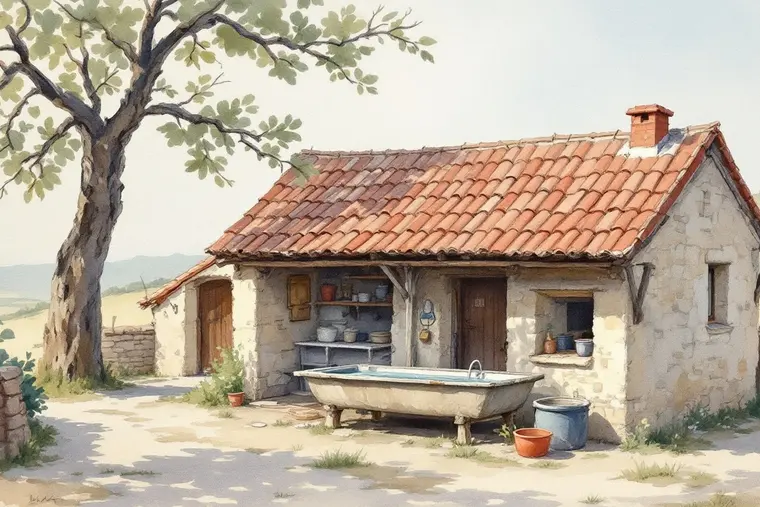
Bezouce is the village that people see through a windscreen. The old road from Nîmes to Avignon, now the D6086, runs straight through it, and the Pont du Gard is only a few minutes further on. Park the car, though, and there is a tidy half day here: a Roman water channel with a bucket wheel sitting on top of it, a church painted from floor to vault, lanes that were once inside a wall, and two producers who will pour you something before lunch.
This route is on foot, takes about three hours without hurrying, and needs no booking. Two of the stops depend on somebody having the key, so there is a paragraph on that too.
Before you start
Use the free car park by the arena. Gard Tourisme lists it as open all year, and it is also the marked start of the cycling loop, so there are signs to aim for. A picnic area stands next to it. If you are coming by coach, train or bicycle, the page on getting to Bezouce has the options.
Go in the morning. The shops keep morning hours every working day, the light is kinder on the stone, and from June to September the lanes are hot by noon. Wear shoes that grip, because the old centre is cobbled.
The tourist office in Nîmes says that a self-guided leaflet on the old centre can be picked up at the town hall, at the museum and in some shops. The town hall desk is listed as open on weekday mornings, so a Tuesday or a Thursday gives you the best chance of finding both the leaflet and an open door.
The arena and what it is for
The arena was built in 1987, which makes it the youngest landmark in the village and the one that tells you most about where you are. It is a ring for bull games in the Camargue manner, with stands around a sand floor. In the course camarguaise nobody kills the animal: men in white try to pluck small ribbons and tassels from its horns and it goes home to its pasture. On an ordinary morning the ring is empty and you can look at the red barriers and the gap that the runners vault over.
Posters near the entrance are the simplest way to learn if something is on. Village fêtes in this part of the Gard run from spring to autumn, and each place has its own week.
The noria park
From the arena it is a short walk to the noria, and this is the stop that makes Bezouce different from its neighbours. A noria is a chain of buckets turned by an animal or a motor to lift water out of a well. The one here took its water from the Roman aqueduct itself, the channel that carried spring water from Uzès to Nîmes over the Pont du Gard. When Rome had gone and the channel no longer flowed as built, the ground still held water and somebody put it to work.
The park was laid out in 2004. According to Nîmes Tourisme it also keeps remains of the canal du Pouzin, a later attempt to reuse the ancient line, and a set of frescoes in mosaic. Panels explain the aqueduct. There are benches and shade, and it is a good place to eat a peach.
If the aqueduct interests you, remember the date 23 March 1999: that is when the stretch in this commune was listed as a historic monument. The neighbouring villages followed within weeks. The longer story, with the bridge, the tunnels and the basin in Nîmes, is in Roman ruins in the Gard.
Saint-André, the painted church
Walk towards the bell tower. The church of Saint-André is at the heart of the old village and its age depends on who you ask. Nîmes Tourisme gives the twelfth century, with an enlargement in the nineteenth. The cycling notes of Gard Tourisme say Romanesque, built about 1150. French Wikipedia prefers the eleventh century and dates the enlargements to 1837 and 1858. All three agree on the main point: a small medieval building was made bigger and taller in the 1800s, with pointed arches.
What everyone also agrees on is the inside. The walls are covered with painting from end to end, the sort of complete scheme that many parishes have since painted over. If the door is locked, look for a notice with service times, or ask at the town hall when you fetch the leaflet.
One date worth carrying in with you: on 8 December 1482 a bishop of Nîmes, Jacques de Caulers, was consecrated here. The bishops were lords of Bezouce from 1269 until the Revolution, so it was their own village church.
The old lanes
The streets round the church keep the curve of a wall that has gone. Bezouce was fortified in 858 after Norman raids, flattened in 1209 during the crusade against the Cathars, and fought over again and again in the wars of religion. The ramparts came down about 1629 on Richelieu's orders. What is left is the plan: narrow lanes, sudden corners, a house that juts out for no reason you can see. The page on the history of Bezouce sets out the dates and says where the sources quarrel.
Look for these as you go:
- the wash house (lavoir), where the village did its laundry and its talking
- the house linked with Alphonse Daudet, who was put out to nurse here as a small child and heard Occitan before he wrote French
- the old cemetery of the early nineteenth century, with the memorial put up after the First World War
- carved door heads, stone benches against the house fronts, and the iron rings where animals were tied
The Daudet connection deserves more than a plaque. Alphonse Daudet and Bezouce separates what is documented from what is repeated.
The museum with no fixed hours
The Francis Gaud archaeological museum holds more than 450 objects, from prehistory to modern times, all of them found in or around the village. Nîmes Tourisme calls it something to see without fail and then, honestly, gives no timetable: you ask the town hall or look at the museum's own Facebook page. Write a few days ahead if it matters to you, and say how many you are. For a small group of keen people it can be the best hour of the day.
Oil, olives and wine
Two addresses finish the walk, and both are on or near the main road.
| Stop | What it sells | Listed hours |
|---|---|---|
| Domaine de la Patience, 61 route départementale 6086 | Organic Costières de Nîmes and Coteaux du Pont du Gard wines, local food, a small exhibition on vines and ecology | October to June: Monday to Friday 9:00 to 12:00 and 14:00 to 18:30, Saturday 9:00 to 12:30. July to September: longer afternoons |
| L'Oulivo, chemin de Labassan et Roule | Olive oil, table olives, local products, cosmetics, with picnic tables outside | Every day, all year, according to its listing |
The wine estate works 90 hectares organically and has a cellar built in 1930. The olive co-operative was founded in 1947 by growers around the village and still lives on the picholine, the green olive of the Gard. Check both listings before you go, since the second was last updated in January 2024. The page on shops and producers has more detail.
A third stop suits anyone who likes tools. The Le Camarguais workshop, a family firm since 1993, makes folding knives in horn and olive wood and takes beginners on short courses by arrangement.
A timetable that works
- 9:00 Arena car park, then the noria park while it is cool.
- 9:45 Church and old lanes. Leaflet from the town hall if it is open.
- 10:45 Museum, if you have arranged it. If not, the knife workshop's showroom.
- 11:30 Olive co-operative for oil and a tub of olives.
- 12:00 Back to the car park for a picnic, or across to the wine shop before it closes for lunch.
In the afternoon you have the choice of the Pont du Gard, eight kilometres or so up the road, or the first slopes of garrigue towards Cabrières and Lédenon. With a bicycle you can have both: the waymarked aqueduct loop starts where you parked.
Is it worth a detour?
If you have one day in the region, no: give it to Nîmes and the bridge. If you have three, yes, because the noria and the painted church are things the famous sites cannot show you, and because it is quiet. Bezouce has 2,348 people by the 2023 census and no queue for anything. Bring a bag for the olive oil, and keep the bottle upright on the way home.
Nearby in the carnet
Alphonse Daudet and Bezouce: the village before the windmill
Alphonse Daudet was nursed in Bezouce before he wrote Letters from My Mill. What is documented, what is legend, and which of his books to read first.
Bezouce village ·