
Olive groves on foot and by bike around Bezouce
A gentle walk among the olive groves above Bezouce, how to read old and working trees, harvest manners, and the longer loop for cyclists.
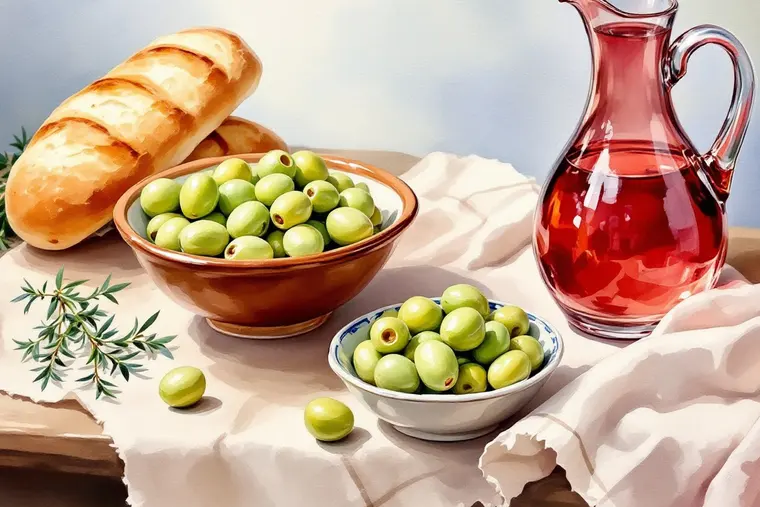
An olivette is a small olive grove, the kind with twenty trees, a wall and a path to the next one. The slope above Bezouce is covered with them. Some are pruned, mown and silver. Others have disappeared into the oaks. A village race used to carry the name round these hills; today you can take the same ground at your own pace.
A short walk, about an hour and a half
There is no separate waymark for this stroll. It uses the first part of the signed cycling route and returns the same way, so you cannot get lost.
- From the arena car park follow the signs "Boucle de l'Aqueduc" by rue de la Source and rue de la Noria to the park with the old bucket wheel.
- Go on by rue du Canal and behind the church of Saint-André.
- Cross the main road with great care, on foot, at a crossing.
- Take rue du Marché aux Bœufs and then the Cabrières road, uphill. Walk on the left, facing the traffic, which is light.
- After the last houses the groves begin. Choose a track with a verge, sit on a wall, and look back. The plain is below, the arena and bell tower in the middle of it.
- Return the way you came.
With another hour you can reach Cabrières, three kilometres from Bezouce in a straight line, and its oil mill.
In summer go before nine. From mid June to mid September look first at the fire map.
The long version
The Boucle de l'Aqueduc is 25.5 kilometres with 295 metres of climbing. Its official description puts olives and water at the centre of the ride, and promises groves, oil mills and dry stone all the way round. It is described stage by stage here.
How to read a grove
| You see | It means |
|---|---|
| Open trees like goblets, clean trunks | Pruned every year or two for picking by hand |
| Several trunks from one root | Killed to the ground in the frost of 1956, and regrown |
| Bushes with suckers to the ground | Not worked for ten years or more |
| Trees in strict lines, thin, with drip pipes | A modern planting for oil |
| Nets folded at the foot | Harvest is close, or just over |
| Oaks and pines between the olives | An abandoned grove on its way back to woodland |
The co-operative's president told a reporter in 2020 that only about a third of the groves in the area were still worked. He gave a density of about 240 trees to the hectare in those that are. Once you know the figure you find yourself counting.
What grows here
Almost all the table olives are picholine, the green olive that was bred at Collias, a few kilometres to the north. For oil the growers of the co-operative also keep lucques, aglandau, bouteillan, cayon, koroneiki and arbequina. Table olives from the defined area can carry the Olive de Nîmes appellation, granted in 1995. How a bitter fruit becomes an apéritif is told in picholine olives.
Walls, huts and water
The stones were cleared by hand and had to go somewhere. They became terrace walls, boundary walls, heaps, and round huts with a doorway facing away from the north wind. Rain runs off the hill fast, so the terraces also held water back long enough for roots to drink it. Break a wall and the soil behind goes with the next storm.
Below the hill the same need had another answer: the noria, lifting water from the Roman channel. The walk starts with one and climbs to the other.
Harvest manners
- Trees that look abandoned have owners. Do not pick.
- Do not step on nets.
- If people are working, say bonjour and go round. If you are curious, ask. There is usually a bottle somewhere.
- Gleaning after the harvest is an old custom that needs permission like any other.
- Dogs on a lead, especially in the lambing months where flocks graze under the trees.
- Take photographs of hands, with leave, and not of faces.
Picking for the table runs from September into October, for oil from October to December.
What you can taste
Finish at the growers' shop on the main road. Ask to try two sizes of the same olive. Then ask for this season's oil beside last season's, if both are open: the new one bites the back of the throat, and the old one has made its peace.