
Nature and environment around Bezouce
Garrigue to the north, pebbly vineyards to the south, a steppe bird protected by Europe, a short river with a long memory of floods, and what visitors can do.
The main road through Bezouce is also a border. Everything north of it belongs to limestone, scrub and springs. Everything south belongs to an old river bed full of stones. A person with a bicycle can cross from one to the other in four minutes, and almost nothing that lives on one side lives on the other.
The two halves
| North | South | |
|---|---|---|
| Ground | Limestone, thin soil | Deep gravels, red clay, round pebbles |
| Cover | Oaks, rosemary, olives, pine | Vines, orchards, fallow, cereals |
| Height | Up to 139 m in the commune, over 200 m beyond | Down to 56 m |
| Water | Springs, dry valleys | Ditches and streams of the Vistre |
| Protected for | The Gardon gorges biosphere reserve | Birds of the Costières plain |
In figures for 2018, quoted in the encyclopedia article on the commune, permanent crops took up 63.3 percent of the territory, mixed farmland 17.9, woodland 10 and buildings 8.7. So this is a farmed place, and what is wild in it is wild between rows.
North: the garrigue
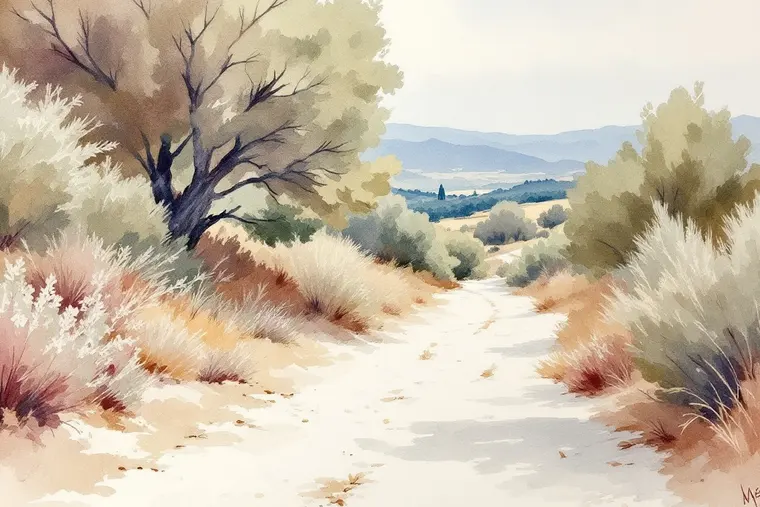
The scrub on the hills is the remains of an oak forest after three thousand years of axes, goats and fire. It is fragrant, spiny, full of flowers in April and shut on the worst days of summer. What is garrigue? is the introduction; olive groves on foot is the gentle walk.
Since 2015 the gorges of the Gardon and the country around them have been a UNESCO biosphere reserve, and Bezouce lies inside its area. A biosphere reserve is not a park with gates. It is a place where people try to live and farm without using up what they live on, and the body that manages it runs a beaver centre at Collias, an exhibition house at Sainte-Anastasie and guided outings.
South: the Costières
The plain is part of a Natura 2000 site named after the Costières of Nîmes, 13,479 hectares designated for birds. Its star is the little bustard, a steppe bird the size of a hen that needs short grass, fallow and quiet. The survey quoted for 2004 found 300 singing males, 60 percent of the breeding males of the region and nearly a quarter of those of France. A separate inventory area, the plain of Manduel and Meynes, covers 9,783 hectares in fifteen communes.
What it means on the ground: stay on tracks between April and July, keep dogs on a lead, and do not fly drones over fallow. A stone curlew or a bustard that leaves its eggs for ten minutes in May has lost them.
The Vistre
The small streams of the commune, among them the Vieux Vistre and the Buffalon, feed the Vistre, which drains the plain of Nîmes and reaches the canals of the Petite Camargue after about 46 kilometres. Most of the year it looks like a ditch. After an autumn storm it is something else. The floods of October 1988, September 2002, December 2003 and September 2005 are the ones that people date things by, and Bezouce was declared a disaster area for flooding in 1982, 1987, 1988, 1990 and 2002.
If rain is falling so hard that you cannot see across the road, do not drive, and never through moving water. The colour-coded warnings are at vigilance.meteofrance.fr and the state of rivers at vigicrues.gouv.fr.
Fire
From mid June to mid September the prefecture may close the hills. The rules for the Garrigues sector are simple: grey and yellow on the map allow access, orange advises against it and forbids camping, red forbids access and movement. All year, in the woods and within 200 metres of them: no fire, no barbecue, no cigarette. If you see smoke, get away from it first, then call 18 or 112 and say where you are and which way it is moving.
Wind and sun
About 2,600 hours of sun a year, little rain in summer, and winds above five metres a second between 40 and 50 percent of the time. The hottest temperature on record at the Nîmes weather station is 44.4 degrees, on 28 June 2019. The coldest is minus 14, in February 1948. Both happened within eleven kilometres of the noria.
What a visitor can do
- Carry water and take the bottle home. The village tip has better things to do.
- Stay on paths in spring, for the birds, and in autumn, for the hunters.
- Pick a pinch, not a bunch.
- Shut gates as you found them.
- Buy from people who farm here. An olive grove that earns something is a firebreak that somebody keeps clear.
- Leave the car at the arena and go on foot or by bicycle.
Local services such as rubbish, recycling and water belong to the conurbation and the town hall, through bezouce.fr.