
What is garrigue? A walker's guide to the scented hills of the Gard
What garrigue means, how people and goats made it, the plants to know by smell and season, what it does to wine and honey, and where to walk it near Bezouce.
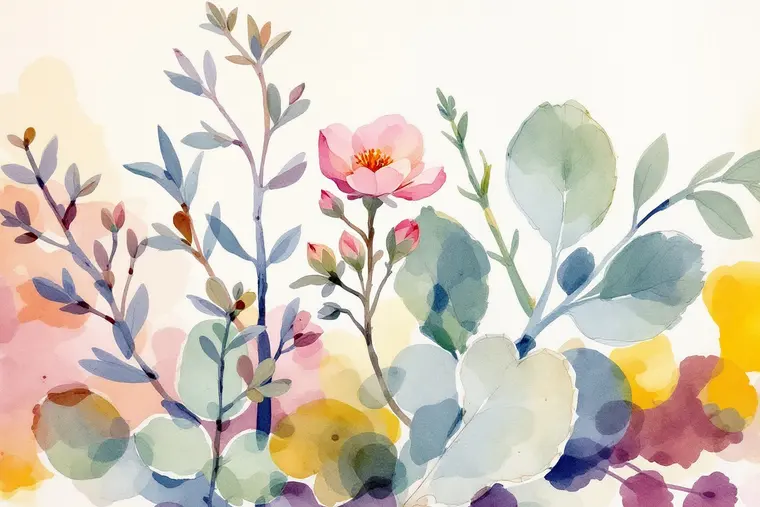
Crush anything you can reach. That is the best first lesson in garrigue, and you can have it at the edge of any lay-by north of Bezouce: a pinch of grey leaf between finger and thumb, then another from the next bush, and within five minutes your hand smells like a kitchen.
The word turns up on wine labels and in holiday brochures as if it were a perfume. It is a kind of country, and a fairly strange one, because it looks wild and it was made by us.
What the word means
Garrigue is low, broken scrub on limestone in the Mediterranean climate: knee-high to head-high bushes, spaced apart, with bare stone and thin soil between them. The encyclopedia definition adds that it grows on alkaline, lime-rich ground and is discontinuous, meaning you can nearly always see where to put your feet.
The French word was borrowed from Provençal garriga and first written down in 1546. It is probably related to older words for rock. Around Nîmes people use it as a place name too: les Garrigues are the hills between the city and the Gardon, and going en garrigue means going up there with a stick and a sandwich.
Garrigue or maquis?
| Garrigue | Maquis | |
|---|---|---|
| Rock | Limestone | Acid, siliceous rocks |
| Height | Low, open | Taller, dense, hard to walk through |
| Typical plants | Kermes oak, thyme, rosemary, white rock rose | Tree heather, strawberry tree, holm oak |
| Where | Gard, Hérault, Provence limestone | Corsica, Maures, Cévennes edges |
The boundary is not strict and botanists admit that usage varies. If you can stroll, it is garrigue. If you need a machete, it is the other one.
How people made it
Go back far enough and these hills were oak forest. From the late Bronze Age it was cleared for fields, grazed by sheep and goats, and cut again and again for firewood and charcoal. Rain carried off the soil once the trees no longer held it. What could live on the rest was garrigue.
It stayed that way while people kept using it. Flocks nibbled the young trees. Charcoal burners, lime burners, glass makers and shepherds lived off it. On the edges, landless labourers cleared tiny plots at weekends, piled the stones into walls and shelters, and planted vines or olives. You walk past the results all the time: the round stone huts called capitelles, enclosure walls that enclose nothing, heaps of stone called clapas.
Then the goats went. In the last century the herds shrank, the plots were abandoned, and the forest started to come back, first Aleppo pine, then holm oak. So the garrigue you see is a stage between two forests, and without grazing or fire it closes up. Fire is never far away: a blaze in 1989 destroyed most of the woodland of Marguerittes, next door to Bezouce.
Ten plants to know
| Plant | How to tell it | When it is best |
|---|---|---|
| Kermes oak | Knee high, tiny holly leaves, green both sides | All year |
| Holm oak | Tree, leaves grey below | All year |
| Rosemary | Blue flowers, needle leaves | January to April |
| Thyme | Grey cushions on the path itself | April, May |
| White rock rose | Crumpled white flowers, sticky leaves | April, May |
| Cotton-leaved rock rose | Crumpled pink flowers, felted leaves | April to June |
| Juniper | Prickles, two white lines on each needle | Berries in autumn |
| Aphyllanthes | Blue star flowers on rush stems | May |
| Mastic | Glossy, resinous smell, red berries | Autumn |
| Wild asparagus | Tangled spines; shoots in early spring | March, April |
Kermes oak is the plant that gives the place its stockings-tearing reputation. It gave it a trade as well. A scale insect that lives on it was gathered for centuries and dried to make a crimson dye.
Spring is the season. By the end of May the colour is over, and in July the hills go grey and silent in the afternoon except for the cicadas. That is the sleeping season here. Autumn rain wakes everything up again and you may find rosemary in flower at Christmas.
Why it smells
Aromatic oils help the plants. They make leaves unpleasant to eat, and they seem to reduce water loss. Some wash into the soil with the leaf litter and slow the growth of rivals, above all the annuals, which helps to keep the bushes spaced out. Hairy and pale leaves scatter the light and are the reason why the hills look grey-green from a distance.
Hot days release the most scent, and the hour after a summer storm is better still.
In the glass and on the spoon
Wine tasters use "garrigue" to mean a note of thyme, bay, rosemary and warm stone in red wines of the south. Whether it gets in through the air, the grape skins or the taster's imagination is a matter for a long evening. The estates on the pebbly plain south of the village have their own notes, as the guide to Costières de Nîmes explains.
With honey there is no doubt. Rosemary honey is pale, early and mild. Thyme is amber and strong. "Miel de garrigue" is a mixture that differs from hill to hill.
Who lives in it
The French description of the garrigue names a few characteristic animals: Montagu's harrier, the Montpellier snake, the ocellated lizard, the hare. The lizard, green with blue spots on its flanks, is the one a walker is most likely to see, sunning itself on a wall. Cliffs and caves in the gorges of the Gardon shelter other protected species, and the managers of the biosphere reserve publish the rules that go with them.
Where to walk it from Bezouce
- Towards Cabrières and La Table Ronde. Quiet lanes climb from the village through vines and olives to open hill at about 200 metres. It is part of the cycling loop and just as good on foot.
- The olive groves on the first slope, for walls and old trees. A short stroll is described in olive groves on foot.
- Combe des Bourguignons, Marguerittes. A two-kilometre interpretation trail among capitelles built by the rachalans, the farm labourers of the seventeenth and eighteenth centuries. The easiest introduction for children.
- Vallon d'Escaunes, Sernhac. A restored valley with an arboretum of Mediterranean plants, capitelles and two Roman tunnels.
- The rim of the Gardon gorges, above Collias or Sainte-Anastasie, where the garrigue meets a cliff. The area is a UNESCO biosphere reserve, recognised in 2015, and has rules about bathing, fires and nesting birds.
Rules of the hills
From mid June to mid September the prefecture can close the massifs on days of very high fire risk. The map for the day and the next is at risque-prevention-incendie.fr: grey and yellow allow access, orange advises against it, red forbids it. No fire, no barbecue and no cigarette in or near the woods, at any time of the year, within two hundred metres.
From September to the end of February there is shooting on many days, mostly at weekends. Wear something bright, keep to the waymarked path, and say hello to the men with orange hats.
Snakes exist and leave. Ticks exist and stay, so look behind the knees. Processionary caterpillars, in late winter, hang in white nests in the pines and walk in lines on the ground. Their hairs are dangerous for dogs and painful for people. Turn round.
What to take and what to leave
Take a litre and a half of water per person in warm months, long trousers for the kermes oak, a hat that ties on, and a map on paper or a downloaded one. Shade on the plateau is rare.
Leave the plants. A pinch of thyme for tonight's supper is tolerated nearly everywhere; a bagful is not, and some species are protected. Leave the stones too. Each one on a wall or a capitelle is holding up two others, and the walls are home to lizards, wrens and, in the cool ones, toads.
Read the ground
A good way to spend a walk is to ask, of each thing you pass, who did this? A strip of deeper soil between two heaps of stone: somebody's vineyard. A line of old olives gone to bushes: frost, then new shoots from the roots. A patch of young pines all the same height: a fire, and the year of it. A hut with the door facing south-east: the mistral, and a man who wanted his lunch out of the wind.
Then pinch another leaf. The theme page on walks has more routes when your boots are dry.
Nearby in the carnet
Cycling the aqueduct loop from Bezouce: 25 km stage by stage
The waymarked aqueduct loop from Bezouce by bike: distance, climb, every stage, the Sernhac tunnel variant, water, heat, fire days and where to taste oil.
Walks and rides ·