
A short history of Bezouce, with the dates argued over
Bezouce from its Gaulish name to the 2023 census: walls and sieges, the bishops of Nîmes, the wars of religion, a king's stay in 1629 and the growth since 1975.
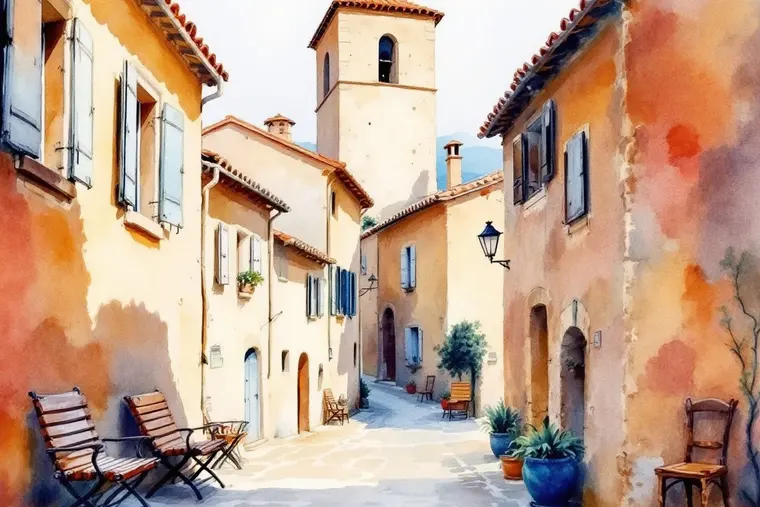
A village on a main road between two cities has a dangerous address. Bezouce was close enough to Nîmes to feed it, to be taxed by it, and to be burned whenever somebody wanted Nîmes and could not get it. Its history is short on heroes and long on rebuilding. The main sources used here are the village page of Nîmes Tourisme and the French encyclopedia article, which quote older histories of Languedoc. Where they part company, both versions are given.
The timeline
| Date | What happened |
|---|---|
| Antiquity | A settlement on grain and vine land outside Nîmes; the aqueduct passes through in the first century |
| 858 | The village is given walls, after Norman raids |
| 1146 | First written form of the name: Biducia or Biduccia |
| 1209 | Destroyed by Simon de Montfort in the crusade against the Cathars |
| 1269 | The land is given to the bishops of Nîmes, who keep it until the Revolution |
| 1384 | The name is written Besocia |
| 1482 | A bishop of Nîmes is consecrated in the church |
| 1562, 1578 or 1579 | Captures, massacres and partial destruction in the wars of religion |
| 4 to 7 July 1629 | Louis XIII stays and receives the submission of the Protestants of Nîmes |
| About 1629 | The ramparts are demolished on Richelieu's orders |
| 1805 | Recognised again as a parish of its own |
| 1837 and 1858 | The church is enlarged |
| 1947 | The olive co-operative is founded |
| 1987 | The arena is built |
| 23 March 1999 | The aqueduct in the commune is listed as a historic monument |
| 2023 | 2,348 inhabitants |
A name with three explanations
Nobody knows what Bezouce means, which has never stopped anybody. One theory, given by the tourist office, is a Gaulish personal or tribal name, Bistucius or Bituscius, made into the name of an estate. A second starts from an Occitan word for a birch wood. A third looks to besoch, a hooked blade for trimming hedges. The first has the support of those who study Roman estate names, the third makes the best story, and the second suffers from the shortage of birches.
In Occitan the place is Bezoça, and its people are Bezouçois.
Granary and channel
Under Rome this was farmland for Nîmes. The great fact of the period is the aqueduct, which came down from the Pont du Gard and crossed the territory on its way to the city. It ran buried for most of its length here, and the village sat on top of it for two thousand years, digging into it when it needed water. The Roman route follows the whole line.
Walls, counts and bishops
The village was fortified in 858, belonged to the counts of Toulouse, and was wiped out in 1209 for that reason when the northern army came south. Sixty years later it passed to the bishops of Nîmes. They were lords here for more than five hundred years, taking a third of the income of the priory of Saint-André, the other two thirds keeping the priest.
Being the bishop's village had its moments. On 8 December 1482 Jacques de Caulers was consecrated bishop of Nîmes in the parish church, with the bishops of Maguelone, Antioch and Uzès around him. The tourist office adds that royal travellers stopped here in the fifteenth and sixteenth centuries, and names Queen Claude, Francis I, the future Henri II and Charles IX.
The wars of religion
Nîmes became a Protestant stronghold. Bezouce stayed Catholic, on the road, ten kilometres off. According to the tourist office it was taken and retaken at least five times, and partly destroyed in a battle in January 1578. Wikipedia gives two massacres of Catholics with pillage, in 1562 and 1579. The difference of a year may come from the calendar or from a copyist. The pattern is clear in any case.
It ended in July 1629, when Louis XIII came through after the peace of Alès, spent four days in the village and received the delegates of Nîmes. Richelieu then had the ramparts pulled down, as he did all over the Protestant south, which must have seemed hard to a place that had been on his side. The line of the wall still shows in the curve of the lanes, as you find on the half-day walk.
The slow nineteenth century
After the Revolution the bishop's rights were gone and the village was too small to count. It was joined to other parishes until a decree of 6 June 1805 made it a separate one. School was in the hands of teaching brothers from 1859, installed by the baron of Fontarèches. The church was made longer and taller in two campaigns and painted inside. The writer Alphonse Daudet was nursed here in the 1840s, when the population was 800.
Then came the diseases of the vine, the decline of small farms and the pull of the towns.
Four hundred years in one column of figures
| Year | People | Year | People |
|---|---|---|---|
| 1793 | 800 | 1975 | 721 |
| 1846 | 800 | 1982 | 1,280 |
| 1872 | 867 | 1990 | 1,625 |
| 1896 | 621 | 1999 | 1,950 |
| 1921 | 516 | 2011 | 2,139 |
| 1954 | 540 | 2023 | 2,348 |
The low point came after the First World War and the turning point in the 1970s. Between 1975 and 1982 the number of inhabitants grew by more than three quarters. Bezouce had become a place where people who worked in Nîmes could build a house with a garden. The latest figures come from INSEE, and what they mean for someone moving here is on the page about living in Bezouce.
What is left to see
From antiquity, the channel under the noria park and the finds in the Francis Gaud museum. From the Middle Ages, the core of the church and the street plan. From the wars, an absence, where the walls were. From the nineteenth century nearly everything that looks old: town hall, church front, wash house, cemetery, stone door frames. The page on culture in the village says how to get in.