
Roman ruins in the south of France: a two-day Gard route
A two-day route through the Roman ruins of the Gard, following one aqueduct from its spring in Uzès to the arena and temple of Nîmes, with costs and timings.
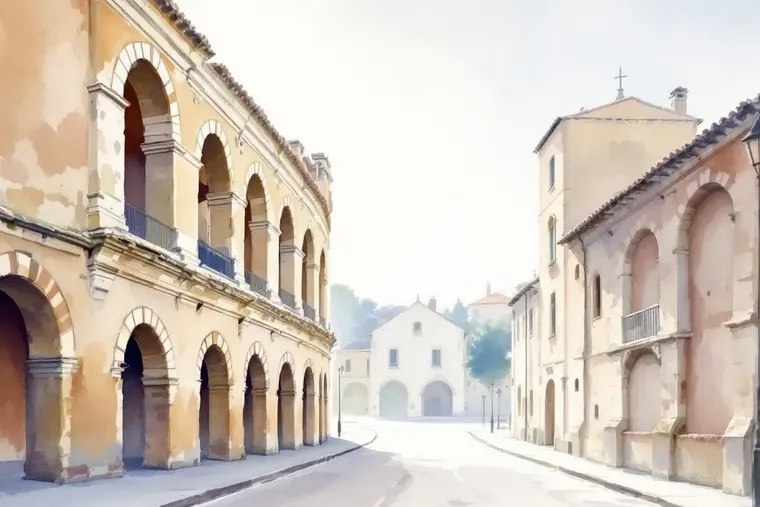
Most lists of Roman ruins in France send you from one famous thing to the next: a theatre in Orange, an arena in Arles, a temple in Nîmes. The Gard can do better than a list. Its monuments are the parts of one machine. Water rose at a spring near Uzès, ran about fifty kilometres in a covered channel, crossed a river on the highest bridge the Romans left us, passed under a village called Bezouce and came out in Nîmes to feed fountains, baths and, in the end, the pride of a city.
Follow the water and the sights arrange themselves into two days. You need a car or a bicycle for the first one and good shoes for the second.
The short version
| Stop | What it is | Time | Cost to see it |
|---|---|---|---|
| Fontaine d'Eure, Uzès | The spring | 45 min | Free |
| Pont de Bornègre, Argilliers | A small bridge of the aqueduct | 30 min | Free |
| Pont du Gard | The great bridge | 2 to 3 h | Site free on foot or by bike; parking 9 euros a car; museum 8 euros |
| Sernhac tunnels | Two galleries cut by hand | 1 h | Free |
| Bezouce noria | A later wheel on the Roman channel | 30 min | Free |
| Castellum, Nîmes | Where the water arrived | 15 min | Free |
| Jardins de la Fontaine, Temple of Diana | Sanctuary of the city's own spring | 1 h | Free |
| Tour Magne | A tower of the Roman wall | 45 min | 4 euros |
| Maison Carrée | The temple | 45 min | 6.50 euros |
| Arena | The amphitheatre | 1 h 30 | 11 euros |
| Musée de la Romanité | The objects | 2 h | 9 euros |
Prices are the adult rates published for 2026 by the Pont du Gard, the Nîmes monuments and the tourist board. A pass for the arena, the temple and the tower costs 14.50 euros.
Day one: the aqueduct
The spring
Start early in Uzès and walk down from the old town into the valley of the Alzon. The Fontaine d'Eure is a group of springs in a green park. Remains of the basin that regulated the flow can be seen, and that is all, but stand there with one number in mind. The spring is at 76 metres above sea level and the basin in Nîmes is only about 17 metres lower. Over some fifty kilometres. A modern engineer with a laser would be careful.
In 2023 a length of ancient channel was found upstream of the known springs, according to the French account of the aqueduct, so the Romans may have collected water even further out, towards Saint-Quentin-la-Poterie.
The small bridges
Between Uzès and the Gardon the channel crossed a string of valleys. The Pont de Bornègre, between Argilliers and Saint-Maximin, is the easiest to see and one of the prettiest: three arches, alone in the trees. Nearer the river, at Vers-Pont-du-Gard, pieces of wall and broken arches stand in the garrigue along marked paths. Nobody will be there. This is where you begin to feel how long fifty kilometres is.
The Pont du Gard
Three tiers, 48.8 metres high, and no mortar in the great arches. The channel ran through the top. The site is open from eight in the morning until midnight, all year, and is free if you arrive without a car. The museum and the other indoor spaces close from November to the end of February and on Monday mornings. If you can, book the guided visit that goes into the channel itself.
A separate page explains how to visit the Pont du Gard from Bezouce, so here is only the advice that matters most: cross it, then go down to the beach and look up for ten minutes without a camera.
The tunnels
After the river the engineers had a ridge in the way. At Sernhac they went through it. Two tunnels can be walked, the Perrotte and the Cantarelles. The tourist board gives them 74 and 60 metres; another of its pages says 66 and 60. Inside you can see the marks of picks, niches for oil lamps and the shafts through which the spoil came up. You can also see mistakes. Teams dug back to back from each shaft and did not always meet in line, so the wall jogs where they corrected it. Bring a torch and keep children by the hand.
Bezouce
The last stop of the day is the least known. In the noria park at Bezouce a bucket wheel drew water from the Roman channel long after Rome. It is a modest thing to look at and a good one to think about: for centuries the village lived beside a monument and used it as plumbing. The stretch here has been listed since 1999. The rest of the village is in half a day on foot.
Day two: Nîmes
Where the water came out
Take the train or bus into town, or leave the car in a covered car park at the edge of the centre, and walk first to the Castellum divisorium on the rue de la Lampèze. It is a round stone basin by the roadside, behind a railing. The aqueduct entered on one side, and holes in the rim fed lead pipes to different quarters. Very few of these distribution basins survive anywhere. Most visitors to Nîmes never see it, though it is the reason for everything they saw the day before.
The city's first spring
Nîmes had its own sacred spring before it had an aqueduct. The gardens laid out around it from 1745, the Jardins de la Fontaine, are the best free hour in the city. At one side stands the so-called Temple of Diana, a roofless vaulted hall that was probably not a temple and not Diana's. Climb through the pines to the Tour Magne, once the tallest tower of the Roman wall, built about 15 BC around an older Iron Age tower. It has lost its top floor and still stands 32 metres high.
The temple
Walk down to the Maison Carrée before lunch or at the end of the day, when the low sun picks out the carving. It is the most complete Roman temple front you will ever stand under, and since 2023 it has been a World Heritage site in its own right. The Pont du Gard has been one since 1985, so this route links two.
The arena
The amphitheatre measures 133 metres by 101, with a wall 21 metres high in two levels of 60 arches. It held more than 23,000 people on 34 rows, seated by rank, with five ring galleries to move them in and out. In the Middle Ages it was a fortress, then a village: houses and chapels filled it until they were cleared in 1809. Walk the highest row all the way round. From there the plan of the place is plain, and so is the view to the hills the water came through.
The museum
Finish at the Musée de la Romanité, the building of pleated glass facing the arena. It shows about 5,000 objects and has a roof terrace that is worth the stairs. Do it last, when you have questions. The lead pipes, inscriptions and mosaics answer several of them.
If you only have one day
Pick the bridge and the arena, in that order, and travel between them by the old road so that you pass through Bezouce and can stop for twenty minutes at the noria. That is spring water, bridge, channel and city in eight hours, with lunch.
If it is raining, reverse the weight: museum and temple in the morning, bridge at the end, since storms here are short and the stone is at its best wet.
Other Rome within reach
You will be tempted further, and the distances are small.
- Arles, half an hour by train from Nîmes, has an amphitheatre, a theatre, underground galleries and a fine museum by the Rhône.
- Orange has the theatre with its stage wall intact, and a triumphal arch.
- Ambrussum, west of Nîmes, has a stretch of the Via Domitia with wheel ruts and a broken bridge in a river.
- Beaucaire has Roman milestones along the same road, and a working replica of a Roman winery at the Mas des Tourelles.
They belong to different stories. This one began in a wet field outside Uzès and ended in a fountain, and it is the only one of its kind that you can follow on foot from end to end. An association of enthusiasts does just that, in nine walks of about ten kilometres spread from October to June, announced in the Gard agenda. Their April walk goes through both tunnels.
In Roman Gard
Nearby in the carnet
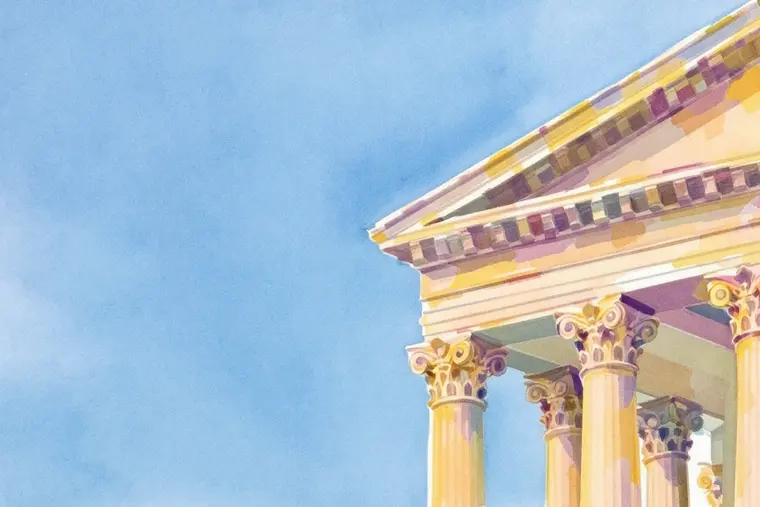
Maison Carrée, Nîmes: how to look at a Roman temple
The Maison Carrée in Nîmes explained: who it honoured, why it is called square, the hidden birds, how it survived, tickets and the best hour to see it.
Nîmes and beyond ·
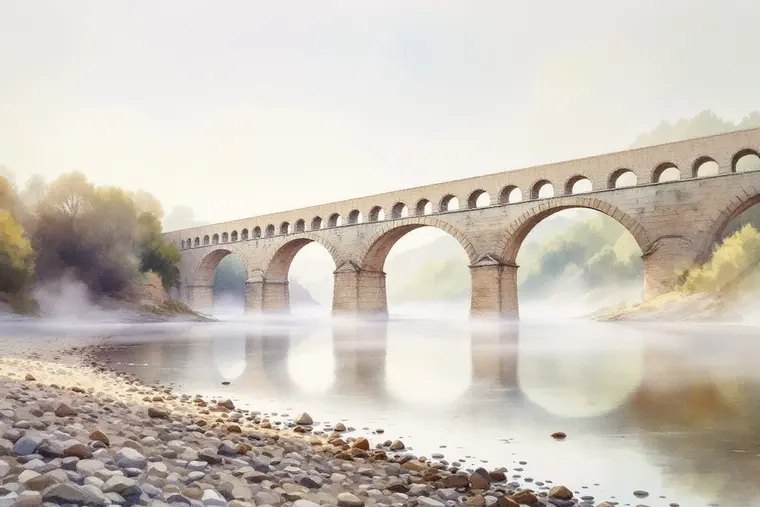
Visiting the Pont du Gard from Bezouce: hours, prices, best light
How to visit the Pont du Gard from Bezouce: the 9 euro car park, what closes in winter, the coach, the bike route, which bank to choose and when to go.
Roman Gard ·