
Maison Carrée, Nîmes: how to look at a Roman temple
The Maison Carrée in Nîmes explained: who it honoured, why it is called square, the hidden birds, how it survived, tickets and the best hour to see it.
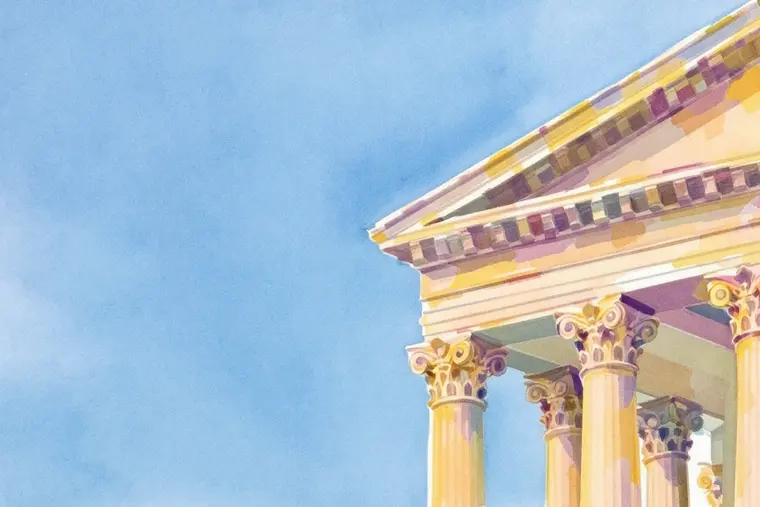
It is smaller than people expect, and it takes a minute for the surprise to turn round and become the opposite. A temple you could put inside the nave of most cathedrals; thirty columns with leaves as sharp as if they had been cut last century; a deep porch that looks straight down into the traffic of a working city. The Maison Carrée has been in use for so long, as one thing or another, that nobody ever got round to ruining it.
It stands fifteen minutes' walk from Nîmes station and about twenty minutes by road from Bezouce. Here is how to get the most from it.
What it was
A temple of the imperial cult. It stood at the south end of the forum, the main square of the Roman colony, and it was dedicated to Gaius and Lucius Caesar, grandsons and adopted sons of the emperor Augustus. Both were meant to inherit the Roman world and both died young: Lucius in AD 2, Gaius in AD 4. The building belongs to those years, or just before and after.
The people it praised had a direct link with the city, because Gaius and Lucius were the sons of Agrippa, Augustus's general and engineer, who had been a patron of Nîmes. So this was not a vague compliment to Rome. It was the colony thanking a family, and reminding the family that it had been thanked.
The tourist board of the Gard says that the design took its cue from the temples of Apollo and of Mars the Avenger in Rome. It copied the fashion of the capital, in local stone, for local eyes.
How the dedication was read
There is no inscription on the front, only holes. Bronze letters were once pinned above the columns and were torn off for the metal. In 1758 a scholar of Nîmes, Jean-François Séguier, studied the pattern of the pin holes and worked out which letters they had held. His reading, with the names of the two young princes, has been argued over in details and accepted in the main. Stand back on the square with the sun at an angle and you can see the dots for yourself.
Why "square house"
It is plainly a rectangle, about 26 metres long and 13.5 wide. In the French of the sixteenth century, when the name is first recorded, a rectangle was called a carré long, a long square. The name stuck after the language moved on.
Five things to find
- The fifteen steps. An odd number, so that a priest who set off on the right foot arrived at the top on the right foot. The left was unlucky.
- The false columns. Only the porch columns stand free. Those down the sides are half-buried in the wall. Temples of this kind, high on a podium and entered from one end, are Roman in plan and Greek in dress.
- The birds. On the west side the carved frieze of curling acanthus hides five small birds. They are easier to find with binoculars, and children are better at it than adults.
- The joints. Look along the wall at eye level. The blocks fit so closely that many appear to be one.
- The colour change. The restoration of 2006 to 2010 cleaned two thousand years of soot from the stone, and darker patches were left in protected corners.
How it survived
Buildings live if somebody needs them. The English account and the tourist board's together give a list of tenants that reads like a comedy:
| Period | Use |
|---|---|
| Antiquity | Temple of the imperial cult |
| Middle Ages | Meeting house of the city's consuls |
| Sixteenth century | Nearly a tomb for a duchess's husband; a private house; a stable |
| Seventeenth century | A church of the Augustinian friars |
| After the Revolution | Headquarters of the new département and its archives |
| From 1823 | A museum |
Each tenant hammered and partitioned and cursed the draughts, and each kept the roof on. In the stable years carts were backed up the steps and the story goes that the fluting of some columns was shaved to let them through. If you run a hand down the porch columns you may feel it.
Colbert, minister of Louis XIV, is said to have thought of carrying the whole thing to Versailles block by block. Thomas Jefferson did something more sensible. As American minister in France he was sent drawings of it, adored it, and used it as the model for the Virginia State Capitol in Richmond. When he finally saw the original in 1787 he wrote that he had gazed at it for hours "like a lover at his mistress". It is one of the few buildings that can be said to have had children.
World Heritage
In September 2023 the Maison Carrée was added to the World Heritage List on its own, as a temple of the imperial cult that shows how the early empire bound its colonies to the ruling family. An earlier application, for a wider set of monuments and the old town, had been turned down in 2018. The narrower case won. The neighbouring Pont du Gard had been listed since 1985, so anyone following the Roman route through the Gard now passes two listed sites in one day.
Tickets, hours and combinations
The 2026 rates published by the manager of the Nîmes monuments are 6.50 euros for an adult, 5.50 reduced. The arena costs 11 euros and the Tour Magne 4. A pass for all three is 14.50 euros, so it pays as soon as you want the arena and one other. Opening hours shorten in winter, when the last visits are in the late afternoon. Check the page before you travel, since events in the arena also move the times there.
What do you get for the ticket? The interior is one room, rebuilt many times, and what is shown in it changes. The outside is the point, and the outside is free. If money is tight, spend it on the arena.
The square and the glass building
The temple shares its square with the Carré d'Art, a library and museum of contemporary art designed by Norman Foster and opened in 1993. It answers the Roman porch with a portico of thin white steel posts. People either like the conversation or they do not. Go up to the café on its terrace: it has the best view in Nîmes of the temple roof, and you can judge.
On the ground, look for the line of the Roman forum marked in the paving. The portico that once enclosed the temple has left column bases below the present level. You stand above the ancient square, which is why the temple seems to sit in a shallow bowl.
Temple, not church
One habit to drop before you climb the steps: nobody gathered inside. A Roman temple was a house for a statue and a store for offerings. The crowd stood on the square, facing the porch, and watched the sacrifice at an altar in the open air in front of it. That is why the porch takes up almost a third of the length, why the steps are only at one end, and why the podium lifts the whole thing nearly three metres off the ground. It was a stage set with a god in the cupboard.
Once you know this, the best place to stand is obvious. It is where the congregation stood, in the middle of the paving, a little lower than the modern street.
When to go
Early morning, before nine, the square is empty and the east side is lit. Late afternoon throws the porch into relief. After dark the building is floodlit, and it is worth a detour on the way back from dinner, because the light comes from below and you can see the undersides of the capitals.
Avoid the weekends of the ferias, at Pentecost and in mid September, unless you want a brass band on the steps. On market and festival days parking in the centre is hard and it is easier to leave the car at a tram-bus stop. The page on Nîmes next door says how to come in from the village.
A forty-minute visit
- Ten minutes on the square, walking round it once, close to the wall.
- Five on the steps, reading the pin holes.
- Ten on the west side with the birds.
- Ten on the café terrace opposite.
- Five back at the corner nearest the arena, looking at the profile. From there the side columns close up, the porch opens out, and you see what Jefferson saw.
Then walk up to the Jardins de la Fontaine, seven minutes away along the canal, where the city's story starts. More day plans are filed under Nîmes and beyond.
In Nîmes and beyond and Roman Gard
Nearby in the carnet
Visiting the Pont du Gard from Bezouce: hours, prices, best light
How to visit the Pont du Gard from Bezouce: the 9 euro car park, what closes in winter, the coach, the bike route, which bank to choose and when to go.
Roman Gard ·
Roman ruins in the south of France: a two-day Gard route
A two-day route through the Roman ruins of the Gard, following one aqueduct from its spring in Uzès to the arena and temple of Nîmes, with costs and timings.
Roman Gard ·