
Visiting the Pont du Gard from Bezouce: hours, prices, best light
How to visit the Pont du Gard from Bezouce: the 9 euro car park, what closes in winter, the coach, the bike route, which bank to choose and when to go.
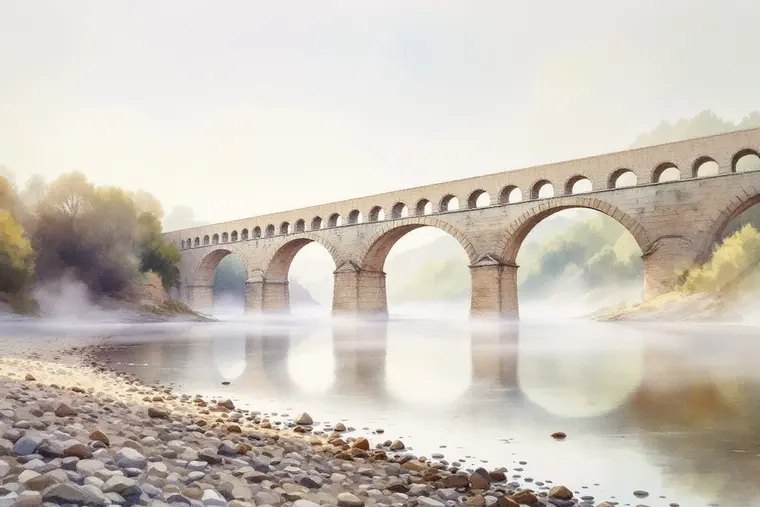
The bridge is so close to Bezouce that people treat it as a local amenity. The water that ran under the village had crossed it first. That closeness is the advantage of staying nearby: you can go twice, once for the stone and once for the light, and skip the hours when everyone else is there.
This page covers the practical side first and the bridge second.
Opening hours and what closes in winter
The estate that manages the monument publishes one set of hours for the site and another for what is indoors. From its practical information page:
| Hours | |
|---|---|
| Site, banks and car parks | 8:00 to midnight, every day of the year |
| Museum, film, children's area: March and October | 9:00 to 18:00 |
| April, May, June, September | 9:00 to 19:00 |
| July and August | 9:00 to 20:00 |
| November to February | Closed |
| Monday mornings | Indoor spaces closed for maintenance |
So a winter visit is a visit to a bridge, a river and some paths, which is enough for many people and cheaper for all. Parking after midnight is forbidden and charged a penalty.
What it costs
Walking or cycling in is free. That surprises visitors who remember a ticket. You pay for three things:
- Parking: 9 euros a car, whatever the number of people and however long you stay that day. Within 14 days of paying you can turn the ticket into a one-year pass on the site's subscription page at no extra cost, which is worth the five minutes if you are staying in the area.
- Museum and other indoor spaces: 8 euros for adults, free under 18.
- Guided visit into the channel at the top of the bridge: 15 euros for adults, 6 euros for children from 4 to 17. It includes the museum, involves some 80 steps, and places are limited. Book it before anything else if you want it.
Holders of a liO regional train ticket get reductions on the last two. Check the figures before you go: they are the estate's published rates and it revises them.
Getting there
By car
Eight kilometres or so up the D6086, then follow signs for Uzès and for rive gauche (left bank, 800 spaces) or rive droite (right bank, 600 spaces). It takes about a quarter of an hour from the village outside summer. The left bank has the main building, the museum and the electric chargers, eight stations installed in October 2025. The right bank is quieter and has the better walk to the bridge.
By coach
The regional line 121 runs between Nîmes, the Pont du Gard and Uzès every day except 1 May, and takes about 45 minutes from Nîmes to the Pont du Gard roundabout. It uses the road through Bezouce. Times change with school terms, so look at lio-occitanie.fr on the day you travel and note the last one back. There is a walk of some minutes from the roundabout stop to the bridge.
By bicycle
The waymarked aqueduct loop passes Saint-Bonnet-du-Gard, from where the greenway leads towards Remoulins and the bridge. It is a pleasant ride with one awkward crossing of the main road. Cyclists pay nothing at the site. Bring a lock.
On foot
Possible for strong walkers by way of Lédenon or Sernhac, but a full day there and back with little shade. Better to take the coach one way.
Which bank, and where to stand
From the right bank you come up through trees and meet the bridge side on, with the river below. A path climbs to a viewpoint above the top tier. From the left bank you arrive by a wide promenade and see it square. Most people cross on the eighteenth-century road bridge that was built against the lowest arches, and that is the place to put your hand on the blocks.
Three spots repay a few minutes:
- The pebble beach downstream on the left bank, for the reflection.
- The viewpoint on the right bank, for the height and for the line of the channel at the top.
- Directly underneath the largest arch, looking up, for the bosses: stones left sticking out of the wall to hold scaffolding.
When to go
Morning light falls on the upstream side, evening light on the downstream side, and the last hour before sunset turns the limestone the colour of bread. In July and August come before nine or after six. In spring the river can be high and brown after storms; in late summer it is low and green, and children jump off rocks where signs forbid it.
Autumn weekdays are the quiet secret of people who live here. The museum is open until the end of October, the coaches thin out, and the plane trees turn. On still winter mornings there is mist on the Gardon and perhaps ten other people.
Avoid the day after very heavy rain. The Gardon is a Mediterranean river, calm for months and then dangerous in hours. If Météo-France has the Gard on orange or red for rain or floods, leave it for another day.
The bridge in six facts
From the general account of its history and engineering:
- It is 48.8 metres high in three tiers of arches and was built in the first century, probably between about AD 40 and 80.
- It carried a channel, not a road. The aqueduct ran some 50 kilometres from Uzès to Nîmes to cover a straight distance of twenty.
- The whole drop from spring to city is about 17 metres. On the bridge itself the channel falls 2.5 centimetres.
- Some blocks weigh six tons. The big arches were set without mortar.
- An estimated 40,000 cubic metres of water a day went through when it was new.
- It may have been in use as late as the sixth century. Lime deposits slowly narrowed the channel, and nobody cleaned it.
After Rome it survived because it was useful as a toll crossing. Pieces of the piers were cut away to widen the path, and that nearly brought it down. Repairs began in the eighteenth century. Traffic and the buildings that crowded its feet were removed at the end of the twentieth, and the present visitor centre opened in 2000.
How long to allow
An hour is enough to see it. Two and a half lets you cross, climb to the viewpoint, walk down to the water and look at the museum. With a swim, a picnic and the marked walk through old farmland on the left bank, called Mémoires de Garrigue, it fills half a day.
There is shade on the banks, a restaurant, drinking water and toilets. Wheelchairs can be borrowed and paths on the left bank are level; the guided visit to the channel is the one part that cannot be adapted.
What to look for on the stone
The upper tiers bend slightly upstream. It was long believed that the engineers had meant this, as a dam is curved against the water. A survey in 1989 found another reason: the stone expands and contracts each day with the heat of the sun by a few millimetres, and over two thousand years that has given the bridge its shape.
Where the channel is open you can see the lime. Uzès water is hard and left a crust on the sides. Archaeologists read those layers like pages: about a century and a half of clean water, then, from the middle of the third century, dirtier deposits that show the aqueduct was no longer being looked after.
Swimming, dogs, drones
People swim off the pebble beaches in summer. There is no guarantee of a lifeguard, the bottom is uneven and the current under the arches is stronger than it looks, so read the board and stay where the others are. Dogs are welcome on a lead outdoors. Drones need permission.
Make a day of it
From Bezouce, a good order is bridge first, lunch second, tunnels third. Go at eight, be back in Remoulins by noon (Friday is market day), and spend the afternoon in the cool Roman galleries at Sernhac. Or put the bridge at the end of the two-day Roman route, in the evening, when you already know where the water was going.
If you need a bed nearer the river, where to stay compares the village with Remoulins, Uzès and Nîmes.
In Roman Gard
Nearby in the carnet
Maison Carrée, Nîmes: how to look at a Roman temple
The Maison Carrée in Nîmes explained: who it honoured, why it is called square, the hidden birds, how it survived, tickets and the best hour to see it.
Nîmes and beyond ·
Roman ruins in the south of France: a two-day Gard route
A two-day route through the Roman ruins of the Gard, following one aqueduct from its spring in Uzès to the arena and temple of Nîmes, with costs and timings.
Roman Gard ·