
Costières de Nîmes wine: a short guide from inside the vineyard
Costières de Nîmes in plain words: where the pebbles come from, the grapes and colours, why it counts as Rhône wine, and how to taste it in Bezouce.
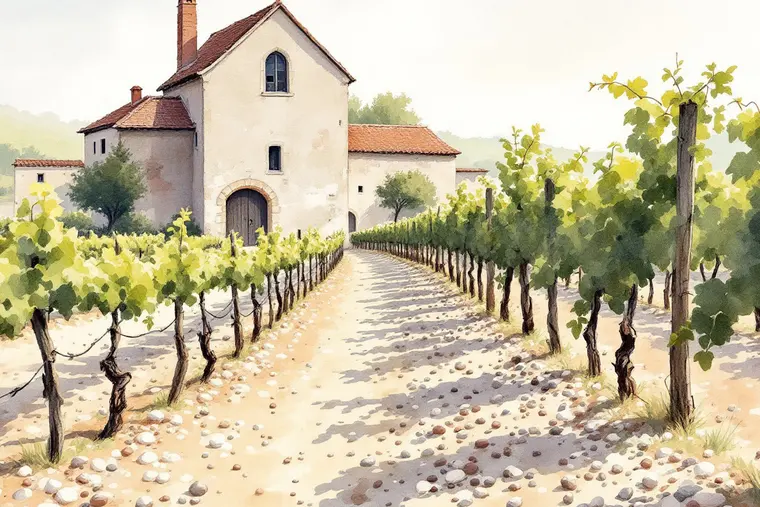
Stand on the south side of Bezouce and the ground changes under your feet. North of the main road it is white limestone and thyme. To the south it is a plain of red earth full of smooth round stones, some as big as a fist, as if a river had passed through and forgotten its bed. That is exactly what happened. The river was the Rhône, the stones are the galets, and the wine that grows in them is Costières de Nîmes.
It is one of the easiest good wines in France to like and one of the least explained. Here is enough to buy it with confidence.
Where it is
The appellation covers the country between Nîmes and the western edge of the Rhône delta, all of it in the Gard. The list of communes has 24 names and Bezouce is one of them, along with Lédenon, Meynes, Redessan and Sernhac among its close neighbours. To the south the vineyard runs down towards Saint-Gilles and the first reed beds of the Camargue.
Three things shape it:
- The stones. Old Rhône gravels mixed with sand and red clay, from three to fifteen metres deep. They drain fast, store the heat of the day and give it back at night. They look like the stones of Châteauneuf-du-Pape because they have the same origin.
- The sea. It is near enough for a breeze on summer afternoons, which slows ripening a little.
- The wind. The mistral dries the bunches after rain, so there is less rot, and that is one reason why organic growing is common here.
Rhône or Languedoc?
Both, depending on the year you ask. The vineyard is geographically in the old province of Languedoc. It was known as Costières du Gard until it was raised to full appellation status in 1986, and took the name Costières de Nîmes in 1989. In 1998 the growers asked to be attached to the Rhône instead, because the style of the wine is closer to it, and the move took legal effect in 2004. So the bottle will be on the Rhône shelf, often at the cheap end, which is good news for you.
The appellation counted its fortieth anniversary in 2026, with dinners and tastings listed on the growers' website.
There is a neighbour to know about. Clairette de Bellegarde, a tiny white-wine appellation inside the same area, stayed in the Languedoc list. If you see a bottle, buy it.
The crocodile on the glass
Many bottles carry a crocodile chained to a palm tree. It is the badge of Nîmes, taken from a coin that the Roman colony struck after the conquest of Egypt. Veterans of the Egyptian campaigns are said to have been settled on the land here, which would make them among the first owners of these vineyards. Wine is older still in the region: Greek traders were selling it along the coast before Rome arrived.
Three colours
| Colour | Main grapes | What to expect | Serve at |
|---|---|---|---|
| Red | Grenache, syrah, mourvèdre, carignan | Dark fruit, pepper, thyme, soft tannin | 15 to 17 degrees |
| Rosé | Grenache, syrah, others in support | Pale to medium pink, dry, red berries | 8 to 10 degrees |
| White | Grenache blanc, roussanne, marsanne, vermentino and others | Pear, white flowers, sometimes almond | 9 to 11 degrees |
Rules on proportions change from time to time and every estate interprets them, so use the table as a compass. If you want one tip: the whites are the surprise. They are made in small amounts, they suit the food of the coast, and visitors usually go home with rosé because nobody told them.
Reds divide into two families. One is made for drinking within two or three years, juicy and best cool. The other is aged, sometimes in oak, and wants lamb or a stew and a year or two more. Ask which you are holding.
IGP and the other names on the shelf
Not everything grown here is Costières. Growers also use IGP Coteaux du Pont du Gard, a regional name with looser rules. It allows single grapes such as viognier, chardonnay or cabernet, in wines that could not carry the appellation. They are cheaper, and often honest fun. Domaine de la Patience, in the middle of Bezouce, sells both.
You will also meet Duché d'Uzès a little to the north, an appellation since 2013 for wines from the hills round Uzès, and Côtes du Rhône across the Gardon. Within half an hour of the village you can drink under four different names.
Tasting in Bezouce
The estate in the village is Domaine de la Patience, on the main road at number 61. According to its tourist board listing, updated in November 2025:
- a family estate of 90 hectares, farmed organically
- a vinification cellar dating from 1930
- a shop with the estate's wines and local products
- an exhibition on the ecology of the vine, and commented tastings
- English, French and Spanish spoken
- bottles from 4 to 13 euros, bag-in-box from 9 to 25 euros
Hours from October to June are 9:00 to 12:00 and 14:00 to 18:30 on weekdays, with Saturday mornings from 9:00 to 12:30. In July, August and September the weekday afternoon runs to 19:00 and the shop reopens on Saturday from 15:00 to 18:00. Look at the listing before a special trip.
In Nîmes the growers' union keeps its own tasting bar, Le Verre des Costières, which is an easy way to compare ten estates without a car. The address and hours are on its website.
How to behave at a cellar door
- Say what you like. "We drink mostly white, dry, with fish" is worth more than pretending to know the grapes.
- Taste light to heavy: white, rosé, red, then aged red.
- Spit. There is a bucket and nobody minds. The driver must, as the legal limit in France is 0.5 grams of alcohol per litre of blood, and 0.2 for new drivers.
- Ask about the vineyard, not the score. Where are the stones deepest? What did last summer do?
- Buy something if you tasted five wines for nothing. Two bottles is polite.
- Mind the heat. A car boot in July cooks a wine in an hour. Bring a cool bag or come at the end of the day.
On the table
Local matches, from easy to ambitious:
- Picholine olives and a cold rosé
- Brandade de Nîmes (salt cod beaten with olive oil) and a white with some body
- Grilled aubergine and anchovy, with a chilled young red
- Gardianne, the bull stew of the Camargue, with an older red
- Pélardon, the small goat cheese of the Cévennes, with a white and not a red
- Strawberries from the plain in spring, with nothing at all, or with rosé if you must
Market shopping for all of this is covered in market days near Bezouce.
The vineyard through the year
Visitors tend to see the vines in full leaf and think that is the whole story. Each season has something to show.
- December to February. Bare wood and pruning. Small fires of cuttings on still mornings. The stones are easiest to see now, and so are the big skies.
- April. Bud break. One night of frost can cost a third of a crop, so growers sleep badly.
- Late May and June. Flowering, with a scent you have to bend down for.
- August. The grapes change colour. Work starts at dawn and stops by noon.
- Late August to early October. Harvest, whites first. Much of it is done by machine at night, with headlights crawling through the dark. Tractors have priority on small roads and should be given it.
- November. The vines turn yellow and rust for about two weeks, and the cellars smell of new wine.
If you want to walk among the rows, use the farm tracks, keep dogs close, and stay out altogether when a sprayer is at work. The plain south of the village is also nesting ground for a rare steppe bird, the little bustard, protected under a European nature designation, as the page on nature around Bezouce explains.
What to take home
Two bottles of white for the surprise, one red that the grower says can wait, and a box of rosé if you have a car. Write the estate's name on your phone. The wines are exported in small quantities and it is pleasant, some wet evening in November or December, to find a crocodile on a shelf a thousand kilometres away.
Nearby in the carnet
Picholine olives: the green olive of the Gard, from tree to bowl
What picholine olives are, where the name comes from, how the green olives of Nîmes are cured, when to buy them and how to keep them at home.
Table and cellar ·