
The mistral wind: what it is and how to live with it in the Gard
What the mistral wind is, when it blows, how it differs from the tramontane, and what it changes for walkers, drivers, gardeners and house hunters in the Gard.
You hear it before you are properly awake. A shutter that was quiet at midnight knocks twice, stops, knocks again. By breakfast the sky is a blue so hard that the hills look cut out with scissors, the laundry is horizontal, and everyone you meet says the same word, with a shrug. Mistral.
The first day is exhilarating. By the third you understand the shrug. If you are spending a week in the Gard, or thinking of a longer stay, it is worth knowing what this wind is and what it is not.
What the mistral is
A strong, cold, dry wind from the north or north-west that blows across southern France to the Gulf of Lion. The encyclopedia entry gives an average of about 50 kilometres an hour with gusts around 100, and cites spells of more than 65 hours. The name comes from the Occitan of Languedoc and means something like "masterly". It is the same word as maestral and maestro.
The cause is a difference in pressure. High pressure builds over the Bay of Biscay, low pressure forms in the Gulf of Genoa, and cold air is pulled south through the gap between the Alps and the Cévennes. The valley of the Rhône concentrates it, though the old picture of a simple funnel is too neat and meteorologists say the mechanism is more complicated.
Bezouce lies on the western side of the mouth of that valley. It does not get the worst, which is further up and further east, but it gets enough to shape the houses.
When it blows
It can come in any month. It is most frequent in winter and spring, and strongest at the change between the two. People here say that it blows for three, six or nine days. Nobody has ever proved it, and nobody stops saying it.
Some figures for the local climate, as published by Météo-France's typology and quoted for Bezouce: about 2,600 hours of sun a year, little rain in summer, very dry summer air, little fog, and strong winds, with a frequency of 40 to 50 percent for wind above 5 metres a second. Five metres a second is only 18 kilometres an hour, a breeze that moves small branches. The number tells you that still days are the exception.
A normal spell has a shape. It arrives behind a cold front, often within an hour, and the sky clears from the north-west. It eases at night and rises again in mid morning. Then one evening it stops, and the silence wakes people up.
There is also a black mistral, mistral noir, which brings cloud and sometimes rain. It is rarer and everybody hates it.
Mistral or tramontane?
Both are cold, dry and from the north-west, and people mix them up.
| Mistral | Tramontane | |
|---|---|---|
| Comes down | The Rhône corridor, between Alps and Cévennes | The gap between the Pyrenees and the Massif Central |
| Felt in | Provence, the eastern Gard, the lower Rhône | Roussillon, the Aude, western Languedoc |
| Around Nîmes | Yes | Often blows at the same time further west |
Nîmes is near the dividing line. If the forecast gives a strong tramontane in Perpignan, expect wind in the Gard too, but from its own door.
The opposite wind matters as much. The marin comes from the sea, warm, damp and grey, and after a day or two of it there may be storms. The weather of the plain is a quarrel between these two, with the marin responsible for the water and the mistral for the light.
What it does that is good
It is easy to complain, so the credit side first.
- Light. The mistral sweeps out cloud, dust and haze. The clear air that painters came to the south for is mostly its work.
- Health of the vines. Bunches dry quickly after rain and rot has less chance, which helps the organic growers of the Costières.
- No frost. Moving air protects the buds on spring nights that would freeze if they were still.
- Dry heat. A summer day of 34 degrees with mistral is far more bearable than 31 without it.
- Drying. Washing on the line in forty minutes.
What it does that is not
- Fire. Dry air, dry plants, strong wind. In summer a mistral day is a fire day, and the hills may be closed to walkers. From mid June to mid September look at the daily map before any walk.
- Cold. Five degrees in January with a strong mistral feels well below freezing. Visitors who packed for the Mediterranean suffer most.
- Driving. Gusts on the motorway bridges over the Rhône and the Gardon push high vehicles sideways. Cyclists meet it on the open plain south of the village like a hand on the chest.
- The sea. It pushes warm surface water away from the coast, so that the temperature for bathers can fall sharply overnight in August.
- Nerves. Local people blame it for headaches and bad temper, and old stories claim that courts were lenient after long spells. There is no good evidence. There is plenty of testimony.
Houses that know about it
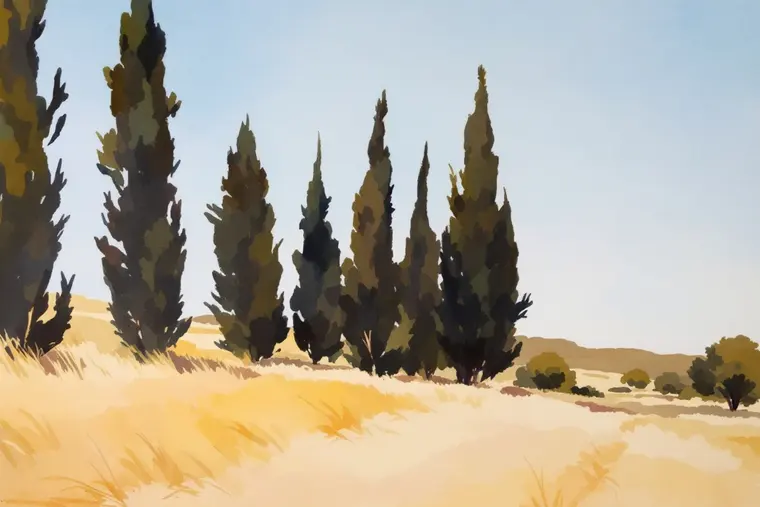
Walk round any old farm on the plain and you can read the wind in the plan. The farmhouse faces south. The north wall has few openings, or none. Roofs are low, shallow and covered in round tiles, weighted at the edges with mortar or stones. To the north stands a hedge of cypresses, close together, clipped or not, and behind them a second line of cane.
In villages the streets bend, so that the wind has to turn corners. Bell towers further east are topped with open ironwork instead of a solid roof.
If you are looking at a house to rent or to buy, test it on a windy day:
- Stand on the terrace. Can two people talk?
- Look at the trees. If every pine leans to the south-east, you have your answer.
- Listen at the north windows. Old single glazing sings.
- Ask where the rubbish bins end up.
- Check that shutters have working catches. A loose one will keep the neighbours awake, and they will tell you.
A courtyard, a south wall and a plane tree are worth more than a view.
Planning a holiday around it
On a windy day choose places with walls. Nîmes is good: the museum, the covered market, the inside of the arena at the lowest rows. So are the Roman tunnels at Sernhac and a cellar visit. In the gorges of the Gardon the cliffs shelter you while the plateau above is being scoured. The Pont du Gard is splendid in wind if you dress for it.
On a still day do the open things: the plain by bicycle, the beaches, the rim of the garrigue, a picnic at the noria.
For riders there is a simple rule. Start into the wind and come home with it. On the aqueduct loop that means riding the hills first, towards Cabrières, while you are fresh.
Pack one layer that stops wind, even in July, and something to keep your hat on. A buff weighs nothing. Contact lens wearers should bring drops.
Hedges before walls
Farmers of the Rhône valley plant hedges of cypress and poplar so that crops do not dry out. It sounds backwards, but a hedge that lets some air through protects more ground than a wall of the same height: solid windbreaks have a much shorter reach and are kept for small plots, where they also store the warmth of the day. So the walled kitchen garden and the long cypress row are two answers to two different problems, and an old farm will often have both.
Forecasts that help
Météo-France publishes a nine-day forecast and, more useful, a vigilance map that colours each département green, yellow, orange or red for wind, rain, storms, heat and flooding. Yellow for wind is common and needs only care. Orange means that trees and roof tiles come down; park away from both. The map is updated at least twice a day.
For the shape of the next two days, look at the isobars if you can read them: high to the west, low over Genoa, lines packed close over the Rhône. When you see that picture, bring in the parasol.
The word and the man
The poet Frédéric Mistral, who won the Nobel Prize in 1904 for a lifetime's work in Provençal, had the name by inheritance. He thought it suited him. In his epic verse the wind is a person of rank, rude, clean and always entering without knocking. It is the best description anyone has managed. Close the gate, put a stone on the newspaper, and wait for the evening it stops.
In Living here