
Course camarguaise: what happens in the ring, and why
A first-timer's guide to the course camarguaise in the Gard: the bulls, the men in white, the cocarde and the strings, the street runs and where to sit.
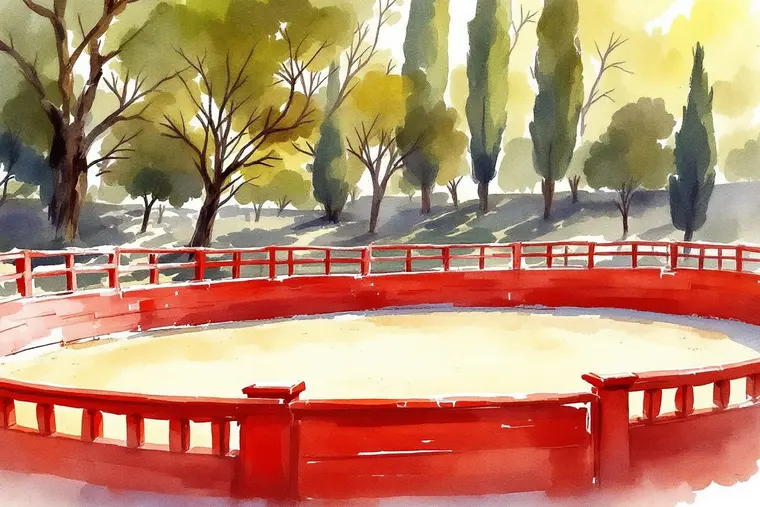
Put aside what you know about Spanish bullfighting. In the villages of the Gard the bull is the star, its name is printed larger than the men's on the poster, and it leaves the ring alive. Some retire with statues. The game is called the course camarguaise, and on a warm Sunday it is the quickest way to understand why a place of two thousand people, such as Bezouce, built itself an arena in 1987.
Here is what you are looking at, in the order it happens.
The bull has the top billing
The animal is a cocardier: a Camargue bull, small, black, light on its feet, with horns that rise like a lyre. French Wikipedia puts the weight at about 250 to 350 kilos, far less than a Spanish fighting bull, and adds that the males are castrated. They live half wild on the marsh pastures of the delta and come to the ring for a quarter of an hour at a time. A good one learns. It remembers the barrier, sets traps, and picks out the runner who is a step slower than yesterday.
The best of the season is given the title Biòu d'or, the golden bull. In bars you will hear its name in the tone that other regions keep for footballers.
Six bulls, fifteen minutes each
An afternoon normally has six bulls. Each stays up to a quarter of an hour. Before the first, the men walk in to the march from Carmen: this entry is the capelado. Then the ring empties, a trumpet sounds, the gate opens, and for a minute the bull has the sand to itself so that everyone can look at it.
A second trumpet lets the men in. They wear white and there are two kinds:
- The raseteurs run. Each holds a crochet, a small iron claw with teeth, in one hand.
- The tourneurs, often older and retired from running, call the bull and place it so that the raseteur can make his line.
A raset is one run: the man sets off on a curve, the bull sets off on another, the two curves meet for an instant, the hand goes to the forehead, and the man keeps going because he has no choice. He hits the barrier at full speed, plants a foot on the red boards and flies up to the rail of the stands. Sometimes the bull comes too. The first time you see a bull jump the barrier you will understand why the front rows lean back.
What they are trying to take
The bull wears attributs, fixed in a set order, and they are worth points and prize money.
| Attribute | What it is | Points listed |
|---|---|---|
| Cocarde | A red ribbon on the forehead | 1 to cut it, 2 to lift it |
| Glands | Two white woollen tassels at the base of the horns | 2 each |
| Frontal | The string that joins them | 1 to cut it |
| Ficelles | Strings wound round each horn, with more turns on stronger bulls | 4 each |
The last string is the hard one. As the minutes go, the speaker announces rising prizes offered by local shops: so many euros for the second ficelle, from the bakery, from the garage, from a lady in row three. If the bull is still wearing it when the trumpet goes, the bull has won, and the band plays Carmen again for the animal as it trots out.
Before and after: abrivado and bandido
The ring is only half of a fête. Gard Tourisme's description of a day goes like this. In the morning families meet in the meadows and eat grilled meat while the gardians, the mounted herdsmen, sort four bulls out of the herd. After lunch comes the abrivado: the riders bring the bulls into the village at a canter, horses packed shoulder to shoulder around them, and young people on foot try to break the formation. When the races are over the bulls go back the same way, usually one at a time, and that is the bandido.
These street runs are exciting and they are the risky part. Barriers go up along the route and you should be behind them, with children, before the first horn sounds. Do not run because others are running.
A small glossary
| Word | Meaning |
|---|---|
| Manade | A breeding herd, and the farm that owns it |
| Gardian | Mounted herdsman of the Camargue |
| Bouvaou | A small yard or ring, often wooden, for handling bulls |
| Simbèu | The old leading ox with a bell that brings a stubborn bull home |
| Capelado | The parade of runners before the contest |
| Fé di biòu | "Faith in the bulls": the passion itself |
| Fête votive, or vote | The annual fête of a village, from two to ten days |
Where it comes from
The game grew out of farm work. Branding and sorting cattle turned into a village show, with a prize hung between the horns. Over time it was called course provençale, course libre, then course à la cocarde. A national federation was founded in 1975 and recognised by the ministry that same year. Since 2008 the course camarguaise has been on France's national inventory of intangible heritage. The great dates of the calendar, such as the Cocarde d'or in Arles and the Palme d'or in Beaucaire, fill large arenas, but the ordinary Sunday in a village ring is where it makes most sense.
Bezouce has hosted its share. In September 2023 the arena held the final of a competition run by the Nîmes conurbation as part of its festival of traditions, as the regional press reported. The ring stands beside the car park where the village walk begins.
Reading a poster
Look first for the name of the competition, because it tells you the level. The national trophies include the Trophée des As for the first rank and the Trophée de l'Avenir for those on the way up. Then read the list of bulls, each with its manade, and after that the list of raseteurs and tourneurs, whose number depends on the size of the ring: from four to twenty men.
Is it cruel?
Nobody is asked to kill or wound the bull, and the rules require the president to stop play if it is hurt. Breeders say with some force that without the game there would be no reason to keep the herds, and without the herds the delta pastures would change. Opponents answer that an animal bred, castrated, transported and chased for entertainment is still being used, and that stress does not leave a visible mark. Animal-rights groups object to the course camarguaise as well as to the corrida. Both arguments are made in good faith, and you can weigh them better after reading this than after a poster.
It helps to know the vocabulary of posters. Course camarguaise, course à l'avenir (for younger bulls and runners) and taureau piscine (bathing-pool games for amateurs) do not involve killing. Corrida and novillada do. Nîmes stages those in its Roman arena during the ferias, and many people who love one will not set foot in the other.
Practical notes for a first time
- Find a date. Ask at the tourist office, read the posters by the arena, or look at the Gard Tourisme agenda of bull events. Dates move with the weather and the school calendar.
- Bring cash for the gate and the bar, a cushion for the concrete, a hat and water. Shade costs more where it exists.
- Sit a few rows up the first time. You see the lines of the runners better, and the barrier seats are for regulars who know when to move.
- Watch the bull, not the men. Note where it stands between attacks. That spot is its home ground and the runs grow more dangerous near it.
- Stay for the sixth bull. Running orders usually keep a strong one for late in the card.
- Leave the dog and the drone behind.
Then eat. A fête means gardianne, a slow stew of bull meat with red wine and rice, served from a pan the size of a cartwheel. A glass of Costières de Nîmes goes with it, and the market days page will fill the next morning if the dancing goes on late.
Nearby in the carnet
Market days near Bezouce: a week of markets in the Gard
Weekly markets around Bezouce by day, with hours: Montfrin, Meynes, Saint-Bonnet, Remoulins, Beaucaire and the famous Saturday market in Uzès.
Markets and seasons ·